A transformative patented hull form delivering 25% reduced fuel consumption — integrating the structural advantages of a monohull with the stability of a catamaran. Five years of independent research. One patent. Two operational vessels.
Revolutionary Invention
Y-Hull® is a hybrid hull form that intelligently combines the best characteristics of two established hull types — creating something entirely new and patented.
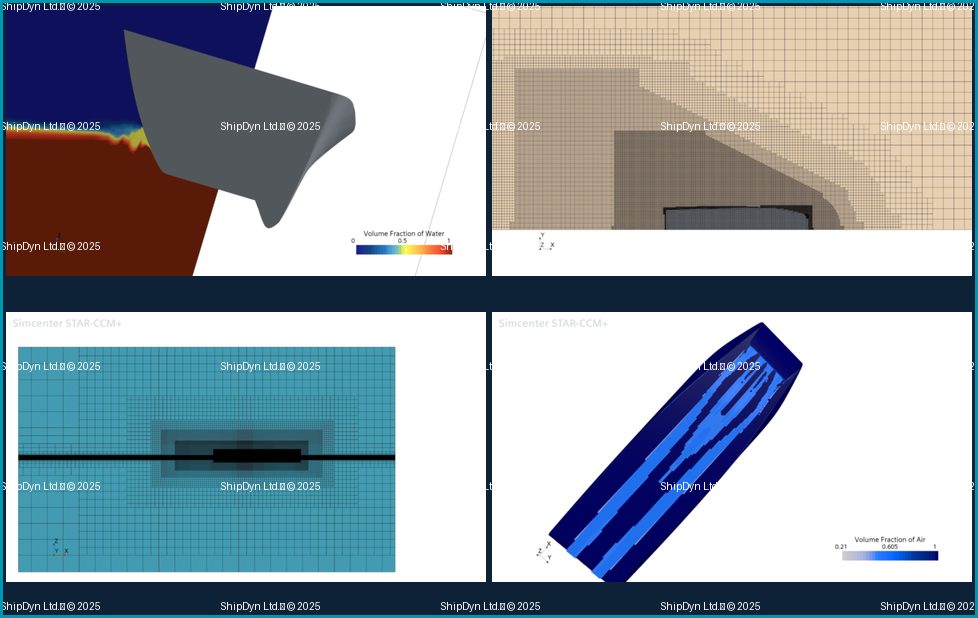
Y-Hull® CFD Simulations · Proprietary Research · ShipDyn Ltd.®
Y-Hull® substantially reduces bow-induced waves, lowering hydrodynamic resistance as the ship moves forward through water.
Technical analysis, along with practically proven data from operational vessels, demonstrates significantly less resistance compared to traditional monohulls and catamarans — directly translating to a 25% reduction in fuel consumption compared to a similar monohull.
The unique Y-Hull® shape automatically allows air to flow underneath the hull from bow to stern. This natural air layer between the hull and water surface reduces frictional resistance — a passive, maintenance-free efficiency gain with no additional systems required.
Integrates the structural and economic advantages of a monohull with the stability and speed of a catamaran in a more efficient way — addressing a long-standing compromise in naval architecture.
Y-Hull® directly addresses GHG challenges in maritime engineering, supporting IMO targets for net-zero emissions from international shipping.
Supported by a peer-reviewed RINA 2019 conference paper and backed by five years of independent research (2014–2019) by the sole inventor and patent holder.
Revolutionary Invention
Y-Hull® is a hybrid hull form that intelligently combines the best characteristics of two established hull types — a monohull and a catamaran — creating something entirely new, patented, and commercially proven.
Y-Hull® substantially reduces bow-induced waves, lowering hydrodynamic resistance as the ship moves forward. This directly reduces the power required for propulsion.
The unique Y-Hull® geometry automatically allows air to flow underneath the hull from bow to stern — creating a natural air cushion that reduces frictional resistance with no additional systems required.
Technical analysis, along with practically proven data from operational vessels, demonstrates significantly less resistance compared to traditional monohulls and catamarans — directly translating to a 25% reduction in fuel consumption compared to a similar monohull.
Twin forward demi-hulls converge into a single stern hull with single-shaft propulsion — combining structural efficiency, stability, and hydrodynamic performance in one patented design.
Y-Hull® directly addresses GHG challenges in maritime engineering, supporting the IMO's strategy for net-zero emissions from international shipping by 2050.
Supported by a peer-reviewed RINA 2019 International Conference paper, extensive CFD simulations using Simcenter STAR-CCM+, and validated against operational vessel data.
CFD Simulations using Simcenter STAR-CCM+ · Proprietary Research
Hull Form
The defining feature of the Y-Hull® is its unique cross-sectional profile — twin forward demi-hulls that gradually merge into a single stern hull with single-shaft propulsion. This geometry creates the natural air channel that gives Y-Hull® its exceptional efficiency advantage.
The hull was designed, analysed and validated across a comprehensive CFD simulation programme using Simcenter STAR-CCM+, covering multiple Froude numbers and displacement conditions.
Y-Hull® 3D Design Render — ShipDyn Ltd.® Proprietary
Explore Further
Full CFD results, design overview, and operational performance data from deployed Y-Hull® vessels.
View on y-hull.com →From concept in 2014 through patent grant in 2019 to commercial deployment — the Y-Hull® innovation journey.
View Timeline →Explore Y-Hull® licensing for new build or retrofit. Commercial terms available for qualified shipowners.
Explore Licensing →The Journey
The Y-Hull® represents five years of dedicated independent research, progressing from concept through rigorous CFD testing to a granted patent and two operational vessels.
Independent research initiated by Amitavo C Wye — identifying inefficiencies in existing hull forms and conceptualising the Y-Hull® solution.
Extensive CFD simulation using Simcenter STAR-CCM+, model testing, and hydrodynamic analysis — including validation of the auto air lubrication effect.
Singapore IPOS Patent granted. Peer-reviewed paper presented at RINA 2019 International Conference.
Two operational Y-Hull® vessels built and deployed. Licence agreement with EcoNavis Solutions Ltd. for UK and European commercialisation.
Key Credentials
The Y-Hull® research programme has attracted significant international recognition and prestigious funding from leading organisations worldwide.
Credentials & Grants
Licence Y-Hull®
Contact us to discuss Y-Hull® retrofit, new build licensing, or research collaboration.
Contact ShipDyn UK →